
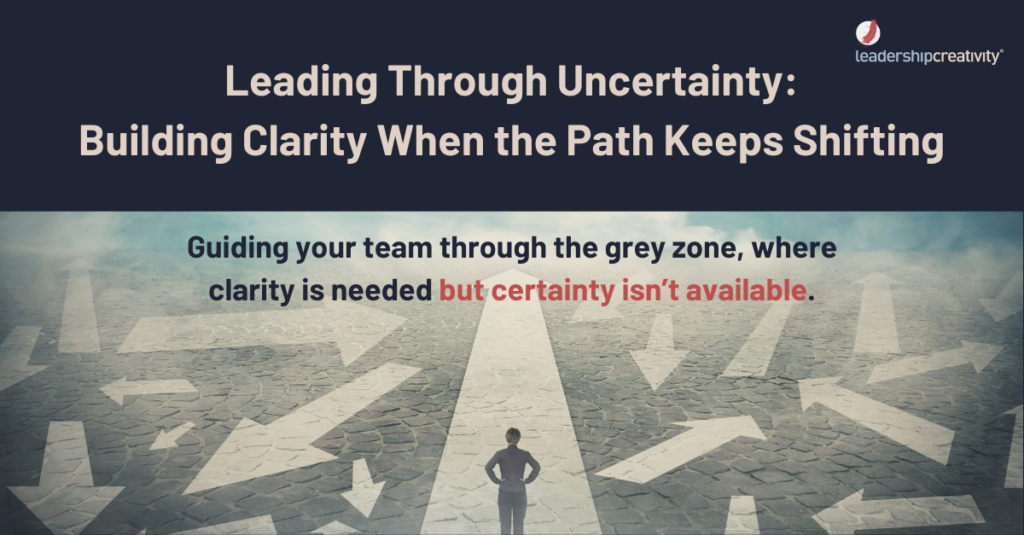
If the past few years have taught leaders anything, it’s this: uncertainty isn’t a temporary disruption, it’s the environment we now lead in. Markets shift quickly, customer expectations evolve overnight, and internal priorities can change just as fast. The leadership challenge is learning how to lead when the path ahead is unclear.
Because uncertainty doesn’t just affect strategy, it affects people. Teams feel it, leaders feel it and the organisation feels it in performance, culture and momentum.
When things are ambiguous, alignment becomes fragile. Not because people don’t care, but because most humans crave direction. We want to know what matters today, what’s expected of us, and how to move forward without second (and third!) guessing every decision. When clarity is missing, confusion fills the gap, and confusion left unchecked, becomes frustration.
Why Uncertainty Hits Teams So Hard
Uncertainty creates cognitive load. People spend more time thinking about what might happen rather than focusing on what is happening. We hesitate, we wait for more information. We hold back ideas because we’re unsure whether they’re still relevant. Productivity doesn’t drop because people are disengaged, it drops because they’re unsure where to aim their energy.
This is where leadership becomes pivotal. In uncertain environments, silence is not neutral. It is interpreted and often, it’s interpreted negatively and with a side-helping of fear.
Clarity vs. Certainty: Leaders Often Confuse the Two
One of the biggest misconceptions we see in our work with leaders is the belief that clarity requires certainty. It doesn’t.
Certainty is about having the answers. Clarity is about communicating today’s reality. You can lead with clarity even when the future is still forming. In fact, that’s when clarity matters most.
Clarity sounds like:
- “Here’s what we know right now.”
- “Here’s what we don’t know yet.”
- “Here’s what’s staying the same.”
- “Here’s what we’re focusing on this week.”
- “Here’s when you can expect the next update.”
These simple statements reduce anxiety, restore focus and rebuild alignment, even when the bigger picture is still emerging.
The Leadership Behaviours That Strengthen Alignment in Uncertain Times
Through our work with leaders and teams, we’ve seen a consistent pattern: alignment isn’t just lost through major decisions, it’s also lost through micro‑behaviours like a rushed update, a vague message or a delayed communication.
We’ve had it happen to us in our corporate careers without realising the impact. Back in time, Craig was busy on a high-stress project and was moving from meeting-to-meeting deep in thought, looking down, appearing worried and stressed. This was interpreted as ‘something has gone terribly wrong on the project’ by a project team member. Rumours abounded for the next 24 hours until it was brought to Craig’s attention. He then let every one know, “I was just deep in thought, we’re all good”.
These moments accumulate, and teams feel them.
The reverse is also true. Alignment is strengthened through small, intentional behaviours that signal stability, presence and care.
Here are the behaviours that matter most:
1. Name What You Know
Even if it’s incomplete. Even if it’s evolving. People don’t need the full picture, they need an anchor.
2. Name What You Don’t Know
Uncertainty becomes less threatening when it’s acknowledged. Pretending to have answers erodes trust faster than admitting you don’t.
3. Shorten the Communication Cycle
In uncertain environments, long gaps between updates create anxiety. People will often fill gaps with guesswork and negativity (and bring their colleagues along for the ride!). Short, frequent check‑ins build confidence and momentum.
4. Reinforce What Isn’t Changing
Stability is a powerful antidote to ambiguity. When people know what remains constant, they feel safer navigating what doesn’t.
5. Invite Questions Early
Questions aren’t always a sign of resistance; they’re a sign of engagement and that people are engaged with the change journey. Curiosity can be a trust‑builder if we respond with clarity and take ownership to find any answers we don’t yet know.
6. Repeat Key Messages
Clarity isn’t created through a single announcement. It’s created through repetition, consistency and reinforcement. Sometimes it feels like you’ve said the same thing over and over, yet people may still not hear it or act on it. People need to hear the same message many times over to really take it in.
Why Alignment Matters Even More in Uncertain Times
When teams are aligned, they move with confidence. They collaborate more effectively, make better decisions and stay focused on what matters most. Alignment doesn’t remove ambiguity, but it gives people a shared direction through it.
Leaders who communicate clearly, consistently and compassionately create environments where people can still perform, still contribute and still feel connected, even when the future is shifting.
The Opportunities Hidden Inside Uncertainty
Uncertainty isn’t just a challenge, it’s an opportunity for leaders to strengthen trust, deepen alignment and elevate team performance. When leaders show up with clarity in the grey zone, teams feel it. They respond to it and they grow because of it.
If you’d like support in leading your team through uncertainty and building clarity when things feel ambiguous, we’d love to help.